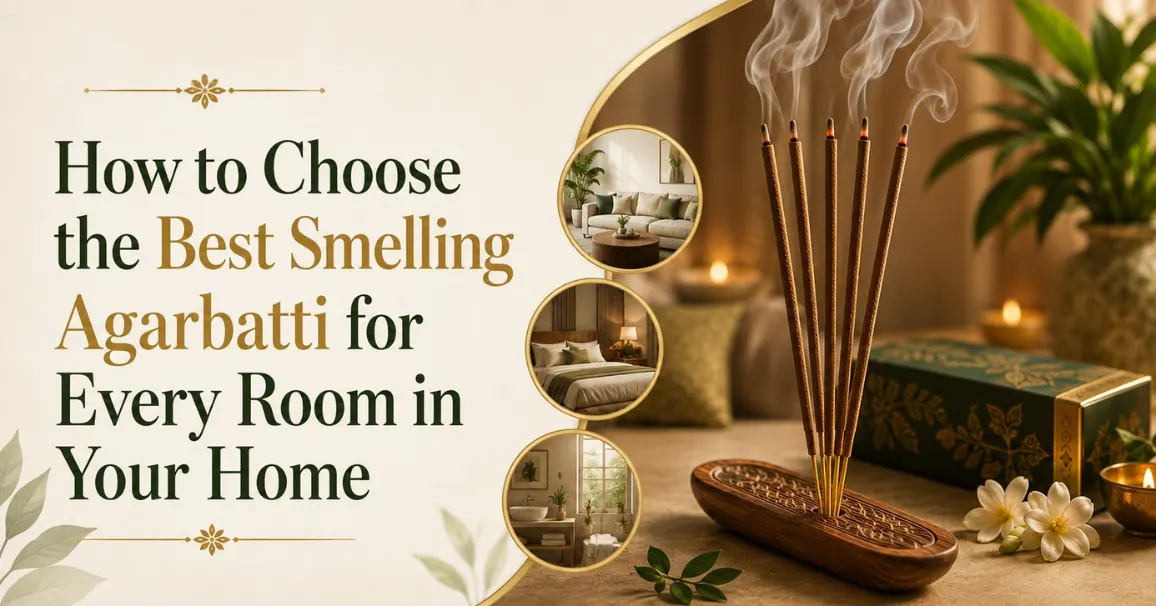
How to Choose the Best-Smelling Agarbatti for Each Room in Your Home?
In Maharashtrian households, the significance and use of Agarbatti go beyond the worship routine. While creating a fragrant, welcoming effect in the morning, it creates a calmer environment in the evening.
However, each room has its own unique mood. Therefore, the best-smelling Agarbatti that sets the tone in your living room may not necessarily suit the bedroom. That’s also because you have a broad array of fragrance options to choose from. So, how do you select premium Agarbatti for each room in your home? Let’s find out in this blog.
- Understand the Various Fragrance Families
This might seem a little technical to many. But knowing the different aroma families often feels handy when choosing the best fragrance Agarbatti for your home. So, here are some commonly used and sold groups.
- Woody: Sandalwood and cedar-inspired scents are warm and traditional.
- Floral: Rose and jasmine create a softer, more familiar atmosphere.
- Fresh: Citrus and lighter aromatic blends to make spaces feel fresher.
- Earthy: Loban, guggul and resinous aromas have a deeper, more traditional character and are usually preferred while performing rituals.
Fragrance isn’t about how good something smells. It is often associated with the character as well. Each room has its own. So, the next point is about matching the aroma with the character and purpose of the room.
Align the Aroma with the Purpose of the Room
Every room in your house has a unique purpose.
For instance, the Pooja room is where you perform religious activities. Therefore, in this room or section of your house, you must choose varieties such as sandalwood, Chandan, rose or traditional devotional fragrances.
On the other hand, the living room is where you gather, gossip and serve guests. So, mild varieties, including jasmine, rose and lavender, work well.
The bedroom is where you seek solace after a tiring day. Now, the purpose of each room is different and so should the fragrance you choose. Thus, lighter aromas such as lavender or white sage can help you feel relaxed.
Besides, if you work from home and have a work desk, you can use aromas that feel pleasant and help you feel fresh, without being distracting.
- Consider the Room Size
This is yet another crucial consideration. Often, people admire the smell of an Agarbatti in a large hall, enquire about it and try it at their home. But usually, they feel different and, precisely, disappointed. That’s because each incense stick comes with its unique intensity levels. Therefore, what feels pleasant in a larger room feels overpowering and suffocating in a smaller space.
So, how do you deal with this? The key is to choose an Agarbatti that suits your room size. Usually, for smaller rooms, mild or low-smoke Agarbatti varieties work well. Besides, you must avoid burning several sticks together. Larger rooms can accommodate more noticeable aromas, particularly when and where the airflow is adequate.
What’s worth noting here is that stronger doesn’t always mean better. The room size also matters. In many cases, stronger fragrances may cause discomfort, compelling people to step out or move away from the smell.
- Consider the Local Weather
This might come as a surprise to many. But yes, the prevailing weather surely matters. For example, during the wet season, cities such as Mumbai, Sindhudurg, Raigad and Ratnagiri feel considerably humid. The weather inside homes might feel slightly cooler due to artificial ventilation. However, overall, the weather remains largely humid.
Therefore, during such seasonal damp spells, you must avoid combining heavy aromas. Instead, a fresh, woody or mildly floral premium Agarbatti can feel more comfortable, while keeping the indoor environment more pleasant.
On the other hand, in drier, cooler regions such as Pune, Satara and Nashik, you will have more flexibility in choosing the better, richer aromas.
- Check Out the Smoke Levels
Heavy smoke can cause irritation, suffocation and significant discomfort, particularly in smaller, less ventilated spaces. If your home is compact or has fewer natural ventilation outlets, you must consider buying incense sticks that produce a lesser amount of smoke.
Accordingly, while choosing a premium Agarbatti, you shouldn’t judge the quality only by the richness of the fragrance. Additionally, you must consider the stick’s by-product. Adequately fragrant Agarbatti varieties with less smoke could be your choice for home use.
In addition to the above, you must check how long the fragrance lasts to burn fewer sticks throughout the day.
Next, you must also avoid buying sticks based merely on packaging. Beautifully packaged scented incense sticks attract attention. However, the packaging doesn’t necessarily decide the product’s quality.
Want Your Home to Feel More Fragrant, Pleasant?
With a legacy that spans nearly 50 years, choose Laxmi Sugandhalay’s aroma incense sticks. With a mind-boggling variety of the best-smelling Agarbatti, including sandalwood, jasmine, Oudh, Kasturi and more, we’ve got the type of Agarbatti and fragrance you need to keep each room of your house pleasant and aromatic. Click to explore our product range and tune into cheerfulness by ordering our products.
Frequently Asked Questions
Which best fragrance Agarbatti is well-suited to a Maharashtrian kitchen?
Lighter, refreshing, fresh fragrances such as citrus are better-suited to Maharashtrian kitchens that often involve heavy cooking and the extensive use of masalas and oil.
How many scented incense sticks should I burn at once?
Usually, one per room is enough. Larger rooms may need more. Yet, avoid burning too many of them as the smoke released may cause discomfort.
What’s the best-smelling Agarbatti for a Pooja Ghar in a Maharashtrian home?
Traditional notes such as Prajakta, Sonchafa and Chandan (Sandalwood) are the most widely preferred varieties.


About author